
- News
- City News
- mumbai News
- Only 1/4th of corneal blind get transplants, push for ‘presumed consent’ for donation
Trending
This story is from May 30, 2024
Only 1/4th of corneal blind get transplants, push for ‘presumed consent’ for donation

Another significant point discussed was the necessity to simplify the registration process for corneal transplant centres, ultimately eliminating the requirement for separate, specialised registration for such facilities.

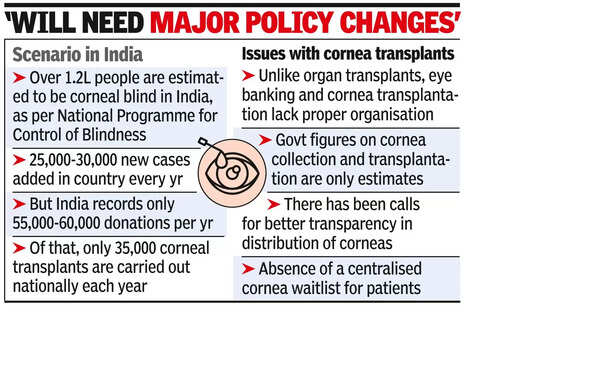
The meeting, chaired by Dr Atul Goel, director of Directorate General of Health Services (DGHS), brought together key stakeholders—including representatives from National Organ and Tissue Transplant Organization (NOTTO), leading ophthalmologists, and eye bank directors from across the country—to address critical issues in cornea donation, retrieval and distribution. With over 1.2 lakh individuals estimated to be corneal blind and an additional 25,000 new cases annually, India records about 60,000 cornea donations a year, with only half of these being transplanted.
A section of cornea donation experts said ‘presumed consent’ could address the significant gap. Presumed consent means cornea can be retrieved from all citizens who die in hospitals without any requirement of family’s consent unless the individual had explicitly opted out.
Dr Anil Kumar, director of NOTTO, confirmed that ‘presumed consent’ was discussed, but said it would require amendments to Transplantation of Human Organs and Tissues Act. He said no final decision was taken.
Jaswant Mehta, chairman, advisory board, Eye Bank Coordination & Research Centre, Mumbai’s largest cornea bank, who attended the meeting, said he has been batting for ‘presumed consent’, particularly in medico-legal cases. “In Mumbai, around 7,000 such cases occur annually, and donations in even 30-40% of them would greatly reduce the transplant waitlist,” he said.
On simplifying registration for cornea transplant centres, most eye banking experts said unlike transplants of liver, kidney or heart, corneal transplants are akin to other eye surgeries like retinal detachment repair or glaucoma surgery. It was proposed that the current registration process be replaced with a self-declaration system. The DGHS head said it could be considered.
Dr V Rajshekhar, assistant commissioner, National Programme for Control of Blindness, said there are 726 registered eye banks in India, but only 200 are operational. He said many registrations are pursued primarily to secure PG seats, and inspections frequently reveal deficiencies in equipment, infrastructure and manpower.
Emphasising on training, Dr Goel said at the meeting how even in big hospitals in Delhi-NCR, resident doctors from ophthalmology refuse to collect cornea citing inadequate training.

About the Author
Sumitra DebroyEnd of Article
FOLLOW US ON SOCIAL MEDIA










Photostories
Hot Picks
TOP TRENDING
Popular Categories
Hot on the Web
Top Trends
Tirupati LadduIsrael Hezbollah WarRahul GandhiShan MasoodBryonna Burrows Net WorthIndian Team Fastest Test FiftyWTC Points TableUGC NET Result 2024GovindaWomen T20 World Cup Points TableWomen T20 World Cup ScheduleEarth Two MoonsIPL Player RegulationsAsteroid 2024 PT5DiddyTop Management Colleges of IndiaLive Cricket Score
Trending Topics
GovindaNavratri Colours 2024Deadpool and Wolverine OTT ReleaseNavratri WishesGandhi Jayanti WishesDevara CollectionGOAT OTT ReleaseGandhi Jayanti 2024Rajinikanth Health UpdateNavratri HistoryDevaraGovinda NewsDevara Movie ReviewHealthy RaitasSwatantrya Veer SavarkarColdplay India tour 2025Upcoming Smartphones In OctoberAmazon SaleSony Bravia 55 inch 4k Ultra HD TVWordle Answer
Living and entertainment
Latest News
Dashing dad Ranveer Singh's dapper looks dole out men's fashion goals - PicsMahima Chaudhry reveals she begged Ajay Devgn and Prakash Jha to keep her near-fatal car accident secret: 'I feared industry boycott'CSK to connect with MS Dhoni in 'coming week', undecided on using IPL uncapped player ruleLibra, Daily Horoscope Today, October 02,2024: Patience will be your best tool todayA night-long musical extravaganza, ‘Raat Pohalo Sharodo Praate’ to usher Devipokkho with unforgettable melodiesElon Musk lost legal battle over unpaid severance to former Twitter employeeBohurupi trailer promises to be a gripping heist drama'CM Yogi's mindset towards Muslims ...': Faizabad MP hits back at BJP in Ayodhya rape caseLate actress Park Ji Ah's co-stars Song Hye Kyo, Park Sung Hoon, and others to attend funeralBill Belichick Leaves Tom Brady Jokes Behind to Join Nike in Boosting Lacrosse, America’s Sport on the RiseMumbai Indians the winners under new IPL retention ruleSurabhi Lakshmi on receiving praise from Akshay Kumar: I never imagined he would remember me; overwhelmed by his wordsIsraeli military announces assassination of key Hezbollah Weapons Commander Muhammad Jaafar QasirKenishaa Francis reacts to backlash over alleged NDA violation in Jayam Ravi and Aarti Ravi's divorce issueStock market today: BSE Sensex rises over 300 points; Nifty50 above 25,850Karan Veer Mehra opens up about 'Kehna Galat Galat'; says 'Surreal experience shooting at fort Gogunda'“Young Guys Will Step Up”: Jerry Jones Addresses Trade Rumors as Cowboys Look Internally for SolutionsMicrosoft brings Google’s AI-powered Circle to Search like feature on Windows 11
Copyright © 2024 Bennett, Coleman & Co. Ltd. All rights reserved. For reprint rights: Times Syndication Service